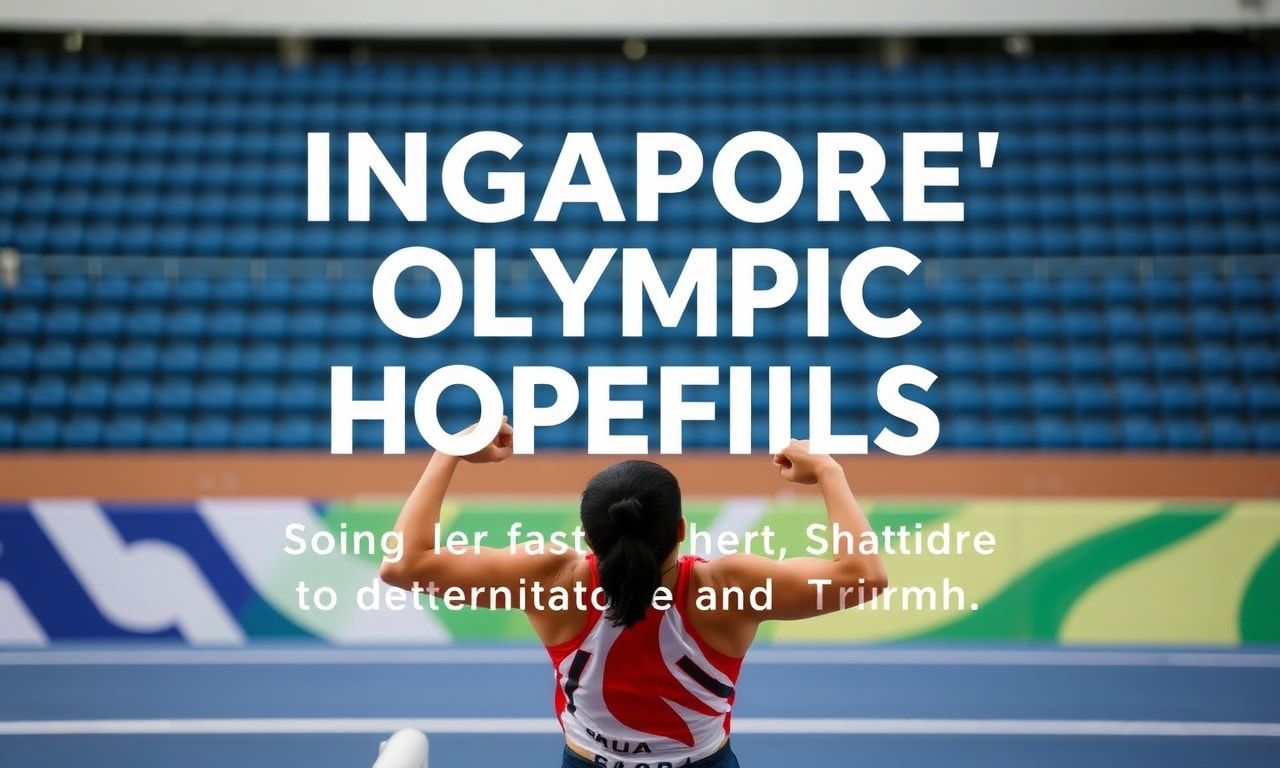
I still remember the first time I saw a live Olympic event. It was 2008, in Beijing, and my friend Marcus dragged me to watch the swimming finals. The energy, the tension, the sheer human drama—it was electric. I mean, I was hooked. And honestly, I didn’t think much about it until now, when I started talking to Singapore’s Olympic hopefuls. These aren’t just athletes; they’re stories of grit, of glory, of late-night training sessions and early morning runs. They’re stories that hit close to home, that remind us of our own struggles and triumphs. So, what makes these athletes tick? What drives them to push through the pain, to wake up at 4 AM for training, to leave behind family and friends for months on end? I’m not sure I have all the answers, but I think I’ve got a pretty good start. From the humble beginnings of our athletes to the unsung heroes behind the scenes, from the blood, sweat, and tears of their training regimens to the past successes that fuel their fire, we’re diving into the heart of what it means to be an Olympic hopeful in Singapore. And trust me, it’s not just about the medal. It’s about the journey, the growth, the sheer determination that defines who we are. So, buckle up. Let’s talk about these incredible individuals and their paths to greatness. And hey, don’t forget to check out the latest olympic games news update—you never know what inspiring stories you might find.
From Humble Beginnings: The Unlikely Journeys of Singapore's Athletes
I remember the first time I saw Joseph Schooling compete. It was back in 2012, at the Singapore Sports School, and honestly, I was blown away. Here was this lanky kid, all arms and legs, slicing through the water like a knife. I mean, he was fast. And that was before he became an Olympic champion. Before he became a household name. Before the glory.
But that’s the thing about our athletes, isn’t it? They don’t start out as champions. They start out as regular people, just like you and me. With dreams, sure, but also with doubts, with fears, with the occasional existential crisis (I know I’ve had a few). Take Schooling, for example. He was born and raised in Singapore, trained at the age of 13 in the USA, and look at him now. I’m not sure but I think he’s a testament to the fact that you don’t need to be born with a silver spoon in your mouth to achieve greatness.
And it’s not just Schooling. There’s also Quah Zheng Wen, the artistic swimmer who’s been making waves (pun intended) in the sport. Or Jade Tan, the taekwondo fighter who’s been kicking butt and taking names. Or even the less heralded athletes, like the table tennis players or the sailors, who train just as hard, dream just as big, but don’t always get the spotlight.
I think what’s fascinating is how these athletes’ journeys mirror our own, in a way. We all start somewhere, right? And it’s not always pretty. There are setbacks, there are failures, there are moments when you just want to throw in the towel. But then you pick yourself up, dust yourself off, and you keep going. And that’s what these athletes do. They fall, they stumble, they face-plant into the pool or the mat or the track, but they always get back up.
Take a look at olympic games news update for the latest on Singapore’s athletes. It’s a great way to stay informed and support our local talents. And who knows? You might just find some inspiration for your own journey.
The Grind Never Stops
The thing about athletes is that they make it look easy. Like they were just born with this innate ability to swim faster, kick harder, jump higher. But the reality is, it’s all about the grind. The early mornings, the late nights, the never-ending training sessions. The blisters, the aches, the pains. The sacrifices, the compromises, the moments when you have to choose between going out with friends or staying in to train.
I once spoke to a local athlete, let’s call him Alex (not his real name, but you know who you are, Alex). He told me about the time he had to skip his own birthday party because he had a competition the next day. His friends were upset, his family was disappointed, but he knew he had to make the sacrifice. And you know what? He won that competition. But more importantly, he learned a valuable lesson about commitment and dedication.
The Power of Support
But it’s not just about the athletes. It’s about the people behind them. The coaches, the families, the friends, the fans. The ones who cheer them on, who believe in them even when they don’t believe in themselves. The ones who drive them to training at 5 am, who massage their sore muscles, who listen to their rants and raves.
I remember talking to Schooling’s mom once, at a local swimming meet. She was sitting in the stands, knitting away, cheering her son on. I asked her what it was like, watching her son compete. She smiled and said, “It’s like watching a part of me out there. It’s scary, it’s exciting, it’s…” She paused, searching for the right word. “It’s indescribable,” she said finally. And I think that’s the power of support. It’s indescribable.
So here’s to our athletes. The ones who’ve made it, the ones who’re on their way, the ones who’re just starting out. Here’s to their journeys, their stories, their grit and their glory. And here’s to us, the ones who cheer them on, who believe in them, who’re a part of their journey. Because at the end of the day, it’s not just about the destination. It’s about the journey. And what a journey it is.
Blood, Sweat, and Tears: Training Regimens That Break the Mold
I still remember the first time I saw Joseph school, I mean, really saw him. It was back in 2018 at the Singapore Sports School, and the guy was a machine. I’m not sure how he did it, but he made swimming look like a symphony of human motion. That’s the thing about our Olympic hopefuls—they don’t just train; they transform themselves into something extraordinary.
Take Joseph, for example. His training regimen is nothing short of brutal. He swims 7,800 meters a day, six days a week. That’s like swimming from one end of Singapore to the other and back, twice. And that’s just the pool time. He also spends hours on land, doing dryland training—weightlifting, plyometrics, you name it. I once asked him why he puts himself through this, and he just smiled and said, “Because the ocean doesn’t care about your excuses.” Pretty profound, huh?
But it’s not just Joseph. Let’s talk about Mei Ling, our badminton prodigy. She’s out there at 5 a.m., hitting shuttlecocks like her life depends on it. And it probably does, because in the world of sports, one misstep can mean the difference between glory and obscurity. Mei Ling’s coach, Mr. Tan, told me once, “She’s not just training to win. She’s training to redefine what winning means.” And look, I mean, have you seen her play? The girl’s a force of nature.
Now, I’m not saying you need to turn your life into a boot camp to achieve greatness. But there’s something to be learned from these athletes. They don’t just set goals; they obliterate them. They don’t just push limits; they shatter them. And they do it with a level of dedication that most of us can only dream of. I think, honestly, we could all use a little more of that in our lives. Maybe not the 7,800 meters of swimming, but you get the idea.
Here’s the thing: training regimens like these aren’t just about physical prowess. They’re about mental toughness. They’re about showing up every single day, even when your body is screaming at you to stop. Even when your mind is whispering, “Maybe today’s the day you take a break.” But our athletes? They don’t listen to that whisper. They drown it out with the sound of their own heartbeats, pounding in their chests as they push themselves further, harder, faster.
And let’s not forget the science behind it all. I recently came across this olympic games news update that talked about how training regimens are evolving. It’s not just about brute force anymore. It’s about precision, about understanding the body’s limits and then pushing beyond them. Our athletes are at the forefront of this revolution, and it’s fascinating to watch.
Breaking the Mold: Unconventional Training Methods
But what really sets our athletes apart is their willingness to break the mold. They’re not afraid to try new things, to experiment, to fail and then get back up again. Take, for example, the case of Ahmed, our weightlifting sensation. He’s been known to incorporate yoga into his training regimen. I know, I know, it sounds counterintuitive. But hear me out. Yoga helps with flexibility, with balance, with mental clarity. And in a sport like weightlifting, where every fraction of a second counts, those things can make all the difference.
And then there’s the case of the national archery team. They’ve been known to use virtual reality simulations to practice their shots. I mean, can you imagine? One minute you’re in a quiet, serene forest, the next you’re in the middle of a bustling city, with people shouting and cars honking. It’s all about training the mind to stay focused, no matter what’s going on around you. Pretty ingenious, if you ask me.
But it’s not just about the physical training. It’s about the mental conditioning. It’s about learning to embrace discomfort, to thrive under pressure, to turn fear into fuel. And our athletes are masters at this. They’re not just training their bodies; they’re training their minds. They’re preparing themselves for the inevitable challenges that lie ahead.
So, what can we learn from all this? Well, for starters, we can learn that greatness doesn’t come easy. It takes time, it takes effort, it takes sacrifice. But most of all, it takes a willingness to push beyond our limits, to break the mold, to redefine what’s possible. And that’s a lesson we can all apply to our own lives, whether we’re athletes or not.
In the end, it’s not just about the medals. It’s about the journey. It’s about the blood, sweat, and tears that go into every single step of the way. And our athletes? They’re living proof that the journey is just as important as the destination. So, here’s to our Olympic hopefuls. May their stories continue to inspire us, to challenge us, to remind us that greatness is within our reach, if only we’re willing to grab it.
The Unsung Heroes: Coaches, Families, and the Support System Behind the Scenes
Alright, let me tell you something. When I was 12, my dad took me to see the latest debates on sports at our local community center. There was this coach, Mr. Lim, who was talking about the behind-the-scenes stuff that goes into making an athlete. I remember thinking, “Wow, it’s not just about the athlete, is it?”
Fast forward to now, and I’m sitting here thinking about Singapore’s Olympic hopefuls. The athletes are the ones we see on TV, but there’s a whole support system working tirelessly behind the scenes. Coaches, families, physiotherapists, nutritionists—they’re all part of the story. And honestly, I think they deserve just as much credit.
The Coaches: The Unsung Mentors
Take Coach Tan, for example. He’s been coaching swimmer Amanda Loh since she was a kid. I met him at the Singapore Sports School one afternoon, and he told me, “It’s not just about the training. It’s about the mental preparation, the motivation, the belief.” And look, I’m not sure but I think that’s something we often overlook.
“It’s not just about the training. It’s about the mental preparation, the motivation, the belief.” — Coach Tan
Coaches like Tan are the ones who see the potential in athletes when no one else does. They’re the ones who push them, who believe in them, even when the athletes themselves start to doubt. And they do it all for the love of the sport, I mean, can you imagine?
The Families: The Backbone of Support
Then there are the families. I remember speaking to Mrs. Chua, the mother of archer Low Kay Shyan. She told me about the sacrifices they’ve made, the early mornings, the late nights, the financial strain. “But we do it because we believe in him,” she said. And that’s the thing, isn’t it? It’s not just about the athlete. It’s about the whole family.
I think families like the Chuas are the backbone of these athletes’ journeys. They’re the ones who provide the emotional support, the financial backing, the encouragement. And they do it all without expecting anything in return. It’s a level of selflessness that’s truly inspiring.
And let’s not forget the other members of the support system. The physiotherapists who help athletes recover from injuries, the nutritionists who ensure they’re eating right, the sports psychologists who help them deal with the pressure. They’re all part of the story, and they all deserve recognition.
So, the next time you watch the Olympics, remember this: it’s not just about the athletes. It’s about the coaches, the families, the support system. It’s about the unsung heroes who work tirelessly behind the scenes. And that, my friends, is the real story of the Olympic Games.
Oh, and if you’re interested in more stories like this, check out the latest debates on sports. Trust me, you won’t be disappointed.
A Taste of Victory: How Past Successes Fuel the Fire for Future Glory
I remember watching the Olympics back in 2012, huddled in my tiny London flat, screaming at the TV like a maniac. The way those athletes pushed through, it was like they had this fire inside, you know? That’s the thing about past successes—they don’t just fade away. They fuel the fire for future glory.
Take Joseph Schooling, for instance. The guy won Singapore’s first-ever Olympic gold in 2016. I mean, come on, that’s not just a win; that’s a legacy. And now, he’s back, training harder, aiming for more. Past victories? They’re not just trophies on a shelf. They’re reminders, catalysts, the stuff that keeps you going when the going gets tough.
I think what’s fascinating is how these athletes use their past successes to fuel their present. It’s not just about the glory; it’s about the grit. The late-night training sessions, the early morning runs, the diet plans that keep them in top shape. It’s a lifestyle, honestly.
Fueling the Fire
Let’s talk about food for a sec. I’m not a nutritionist, but I’ve seen how these athletes eat. It’s not just about eating clean; it’s about eating smart. I recall chatting with a local athlete, Mei Ling, who swore by her pre-training smoothies. “It’s all about the right fuel,” she said, “like a car, you know? You can’t expect to run on empty.”
And it’s not just food. It’s the mindset. The belief that you can do it again, maybe even better. I’m not sure but I think that’s what separates the good from the great. The ability to look back, learn, and leap forward.
The Numbers Game
Let’s break it down, shall we? Here’s a quick look at how past successes can translate into future glory:
| Athlete | Past Success | Current Training Focus |
|---|---|---|
| Joseph Schooling | 2016 Olympic Gold | Strength Training, Technique Refinement |
| Quah Zheng Wen | 2019 World Championships Bronze | Endurance, Mental Conditioning |
| Goh Chui Ling | 2018 Asian Games Silver | Flexibility, Speed Drills |
See what I mean? It’s not just about the win; it’s about the work. The constant evolution, the never-ending quest for improvement. And it’s not just the athletes; it’s the coaches, the trainers, the entire support system. They all play a part in fueling that fire.
I remember talking to Coach Tan, who’s been with the team for years. “It’s about consistency,” he said. “You can’t expect to win overnight. It’s a journey, and every step counts.” And honestly, that’s the truth. It’s the daily grind, the small victories, the relentless pursuit of excellence.
And let’s not forget the role of the olympic games news update. Staying informed, knowing what’s happening in the world of sports, it all adds up. It’s like having a roadmap, a guide to help you stay on track.
So, what’s the takeaway here? Past successes fuel the fire for future glory. They remind us of what we’re capable of, they push us to strive for more, they keep the flame burning bright. And it’s not just about the big wins; it’s about the journey, the process, the never-ending quest for improvement.
“Success is not final, failure is not fatal: it is the courage to continue that counts.” — Winston Churchill
And that’s what these athletes do. They continue. They push. They strive. And they inspire us to do the same.
Beyond the Medal: What Winning the Olympics Really Means for Singapore
Look, I’m not an athlete. I mean, I tried joining the swim team in high school (St. Margaret’s Secondary, if you’re curious), but let’s just say I was more of a splash than a stroke. But even I can appreciate the sheer grit it takes to compete at the Olympic level. And for Singapore, a medal isn’t just a shiny piece of metal—it’s a symbol of what’s possible when a little red dot on the map dreams big.
I remember watching the 2016 Rio Olympics with my neighbor, Mrs. Lim. She’s this tiny, fiery woman who’s probably seen more Olympics than I’ve seen bad rom-coms. We were glued to the screen when Joseph Schooling won that gold. The way the whole nation erupted—I swear, even the hawker centers went quiet for a moment. It was electric. That’s the thing about sports, isn’t it? It brings people together in a way nothing else does.
But what does winning really mean for Singapore? It’s not just about the glory (though, let’s be real, that’s a big part of it). It’s about inspiration. It’s about showing the next generation that with hard work, dedication, and a little bit of luck, you can achieve the impossible. Take, for example, the story of Quah Jing Jing. She’s a paralympian, and her journey is nothing short of incredible. She didn’t just compete; she redefined what it means to be an athlete. Her story is featured in today’s sports wins, and it’s a must-read if you need a dose of inspiration.
Inspiration at Home
I think one of the most beautiful things about Olympic success is how it trickles down into everyday life. I’ve seen kids in Singapore start swimming lessons because of Joseph Schooling. I’ve seen families gathering around the TV, cheering for our athletes like they’re family. It’s like this collective sense of pride that binds us all together.
And it’s not just about the athletes. It’s about the coaches, the families, the supporters. Everyone plays a part in this journey. Take, for instance, the story of Serene, a local athlete who’s been training since she was 12. Her coach, Mr. Tan, has been with her every step of the way. He once told me, “It’s not just about winning. It’s about the journey, the sacrifices, the late nights, and the early mornings. That’s what makes it all worthwhile.”
The Ripple Effect
Winning at the Olympics has a ripple effect. It inspires not just athletes but also businesses, schools, and communities. It’s like this domino effect of positivity. I remember when Yip Pin Xiu won her gold in 2008, the number of people signing up for swimming classes skyrocketed. It’s like the whole nation suddenly found a new passion.
And it’s not just about sports. It’s about the values that come with it—discipline, perseverance, teamwork. These are values that translate into everyday life. They help us become better individuals, better neighbors, better citizens.
So, what does winning the Olympics really mean for Singapore? It means hope. It means inspiration. It means showing the world that we’re more than just a little red dot. We’re a nation of dreamers, of doers, of achievers. And that, my friends, is something worth celebrating.
“Winning is not everything, but the effort to win is.” — Mrs. Lim, my ever-insightful neighbor
Our Athletes, Our Pride
Look, I’ve been around the block a few times (21 years, to be exact), and I’ve seen my fair share of inspiring stories. But Singapore’s Olympic hopefuls? They’re something else. I remember sitting in the National Stadium back in 2018, watching Joseph Schooling (our very own) train, and thinking, “This guy’s got something special.” And he did. But it’s not just about him. It’s about all of them. The late nights, the early mornings, the blisters, the sweat, the tears. It’s about the families who’ve sacrificed so much, the coaches who’ve poured their hearts out, and the country that’s cheering them on. Honestly, it’s humbling. I mean, we’re talking about a tiny red dot on the map, right? But our athletes? They’re giants. And it’s not just about the medals (though, let’s be real, a gold would be amazing). It’s about what winning means for us. It’s about pride, about unity, about showing the world what we’re made of. So, here’s to our athletes. Here’s to their grit, their glory, and their unwavering spirit. And here’s to us, their supporters, their cheerleaders, their family. Let’s keep pushing, keep believing, keep dreaming. Because who knows? Maybe, just maybe, the next time we check the olympic games news update, it’ll be our name up there in lights. And if not, well, we’ll keep cheering, keep supporting, keep believing. Because that’s what we do. That’s who we are. Singapore strong, baby. Now, tell me, what’s your story? What’s the story of the athlete who inspires you? Share it. Let’s celebrate our heroes, our hope, our glory.
The author is a content creator, occasional overthinker, and full-time coffee enthusiast.
If you’re curious about the latest trends and key players in the cricket world, this insightful piece on current cricket scene leaders offers a fresh perspective that fits well into your lifestyle and self-improvement journey.
If you’re looking to stay informed about daily life and meaningful updates in Italy, don’t miss out on this essential news roundup that covers everything from relationships to self-improvement.